

Anise
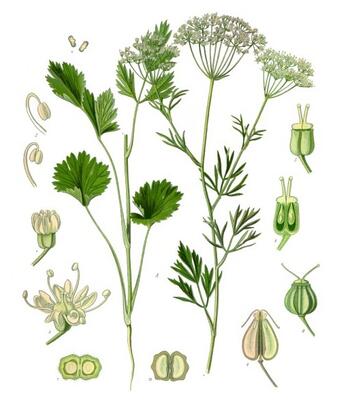
Anise (common anise) belongs to the celery family.
Common anise is an annual herbaceous plant up to 60 cm high with a branched stem covered with short fluff. Leaves are alternate with sheaths; lower stem leaves on thin long petioles, entire, rounded-reniform, serrated. The middle leaves are trifoliate, with wedge-shaped, serrated leaves, petiolate. The upper leaves are sessile, three to five divided into linear segments. Inflorescences are complex umbrellas located at the tops of stems and branches. The flowers are small, white, inconspicuous. The fruit is an ovoid or slightly heart-shaped two-seeded seed, 3-4 mm long, brownish-gray in color, with an aromatic odor. Blooms in June – July, bears fruit in August. The taste of the seeds is spicy, sweetish, the smell is strong and aromatic.
Common anise is not found as a wild plant in Russia. Cultivated in the Voronezh, Belgorod, Kursk regions, the North Caucasus, Ukraine, the Volga region, Bashkiria, Krasnodar Territory and Central Asia. The fruits of the plant are used as medicinal raw materials. It grows wild in southern Europe, India, and Ethiopia. Distributed in culture in Europe, America, Asia. Widely cultivated in Ukraine and the North Caucasus.
The fruits contain fatty oil (from 8 to 30%) and essential oil (up to 6%). The essential oil contains anethole (80-90%), methyl chavicol (10%), anisaldehyde, anise ketone and anisic acid. The essential oil has a characteristic aromatic odor and sweet taste.
Common anise has anti-inflammatory, antispasmodic and expectorant properties. Plant preparations improve expectoration of sputum and its liquefaction, accelerate the evacuation of sputum and products of inflammation of the mucous membrane from the respiratory tract, and have a bactericidal effect. The highest therapeutic effectiveness of anise preparations is observed for respiratory diseases complicated by various bacterial flora.
An aqueous solution of anise enhances intestinal activity, stimulates the functions of the digestive glands, improves digestion, and has an antiseptic, laxative and carminative effect. It has been established that anise oil reduces pain and restores peristalsis during convulsive intestinal spasms, improves digestion, normalizes the secretory function of the stomach and intestines, and improves hepatic and pancreatic secretion.
Anise essential oil is absorbed into the digestive tract, stimulates gastric activity, and then is partially secreted by the bronchial glands, providing some bactericidal effect on the microflora of the respiratory tract. Passing through the bronchi, anise essential oil has a mild expectorant effect and promotes reflex stimulation of breathing, increased activity of the ciliated epithelium of the respiratory tract and increased secretion of the mucous membranes of the trachea, larynx, and bronchi.
Anise essential oil is included in the formulation of many inhalation mixtures; it is added to various kinds of cough drops, often to improve the taste of medicines. Anise oil and the fruits of the plant are included in many medicinal complex preparations.
The homeland of anise is the Mediterranean countries (Egypt, Asia Minor, Greece, Cyprus). It was first mentioned by the ancient Egyptians and Greeks. They used anise as a valuable medicinal and food plant. In ancient times, it was used as a cure for nightmares and snake bites. The plant came to Central Europe from Rome, and in the middle of the 16th century it was already used in Germany. In the Middle Ages, this spice was highly valued and sold at an expensive price. In European countries, freshly baked bread was sprinkled with anise.
Anise appeared in Russia in the 30s of the last century. Currently, it is widely cultivated in almost all European countries, as well as in Asia, Africa and a number of American countries.