

Bearberry leaves
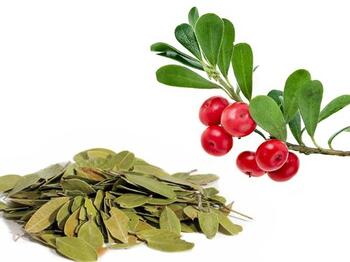
A perennial evergreen shrub with strongly astringent and bitter-tasting leaves. It has anti-inflammatory, antiseptic, diuretic and other medicinal properties.
Heather family. Perennial evergreen shrub. The stem is branched, dense, creeping, up to 1 m long. The leaves are alternate, leathery, obovate, dark green above, light green below. The flowers are small, upturned, whitish-pink, collected at the tops in short racemes. Blooms in May–June. The fruits are noticeable red mealy berries from afar. The berries are readily eaten by birds, and the seeds, not digested in the stomach of the birds, are carried over long distances and, once in the ground, germinate.
It is found in the north of the forest zone of the European part of Russia, in Siberia, the Urals, the Far East and the Caucasus Mountains. Prefers pine forests with dry sandy soil.
In bearberry leaves, up to 35% of tannins of the pyrogallic group, acids (gallic, ellagic, quinic, formic and ursolic), arbutin, methylarbutin, hydroquinone, ella-gotanin, gallotanin, coloring substances, uvaol, hyperoside, quercetin, isoquercetrin, vitamin C were found and essential oil.
Used for kidney and bladder diseases as an effective diuretic, disinfectant and anti-inflammatory agent. Prescribed for acute and chronic pyelonephritis, cystitis, kidney tuberculosis, and urethritis. The effect of bearberry appears when the urine reacts alkaline. Bearberry is included in diuretic preparations No. 1 and 2.
In folk medicine, it is sometimes prescribed for diarrhea (due to its astringent properties), as well as for cholecystitis and gout.
Contraindications
Pregnancy. With glomerulonephritis, it can irritate the renal parenchyma. Sometimes bearberry causes idiosyncrasy with urticaria.