

Bergenia rhizomes
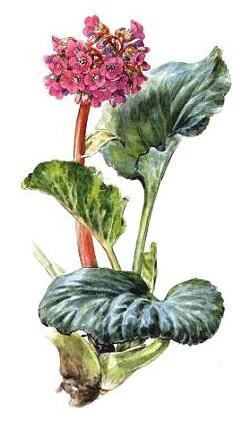
Perennial herbaceous “evergreen” plant 10-50 cm in height or more. It has a thick, fleshy, creeping, highly branched rhizome, with numerous root lobes. The stem is leafless, glabrous. The leaves are long-petiolate, large, bare, entire, slightly fleshy, dark green, turning red in autumn, collected in a dense rosette, usually live for 2-3 years. The leaf blade (length - 3-35 cm, width - 2-30 cm), broadly elliptical or slightly obovate in shape, round or heart-shaped at the base, and with large blunt teeth along the edge. Although bergenia is considered an evergreen plant, its leaves only live for one year. Typically, a leaf appears in the spring after flowering, grows in the summer, overwinters while maintaining a green color, supplies the plant with nutrients in the spring, and then dies off, giving way to young (new) leaves. As new leaves appear, last year's leaves turn red, turn brown, sometimes turn black and dry out. The flowers are small (up to 0.8 cm in diameter), regular (actinomorphic), 5-membered, with a lilac-pink bell-shaped corolla, collected in a dense apical (terminal) paniculate-corymbose inflorescence. Usually inflorescences are on leafless peduncles. The petals are ovate or rounded-ovate at the base with a short wide nail, 2-3 times longer than the calyx. Double perianth. The formula of the bergenia flower is: *CH5L5T10P2. A characteristic feature of the bergenia flower is the presence of hypanthium, which grows to the base of the gynoecium. The fruit is an ellipsoidal dry capsule with two diverging lobes. It blooms in May-June until young leaves appear. The seeds are numerous, small, and ripen in July - early August.
Bergenia thickleaf is considered a Siberian plant; it is widespread in Eastern Siberia, Altai, Western and Eastern Sayan Mountains, as well as Transbaikalia and southwestern Yakutia, where it grows from 400 to 2500 m above sea level. Typical places where bergenia thick-leaved grows are well-drained rocky screes and rock cracks in the subalpine, alpine and upper part of the forest belt (dark coniferous), the so-called “bergenia forest types”. It is found in gravelly tundra, on the banks of rivers and streams. Forms large thickets in area. Bergenia thickleaf is grown in many regions of Russia on personal plots, and it is propagated mainly by rhizomes, since it develops slowly in cultivation.
The leaves of bergenia thick-leaved contain up to 23% tannids, and its rhizomes contain up to 27%. In addition, 25-27% of tannins, phenolic compounds, phenol carbonic acids, a coumarin derivative - beregnin, as well as isocoumarins, catechins, starch, sugars, and mineral salts were found in the rhizomes. The leaves contain gallic acid, coumarins, flavonoids, vitamin C, carotene and arbutin, as well as 2-4% free hydroquinone.
In scientific medicine, bergenia is widely used as a medicinal raw material. Extracts from rhizomes and leaves are mainly used for medicinal purposes. Preparations from bergenia are used for various gastrointestinal diseases, as well as in gynecological practice as a hemostatic agent and for the treatment of a number of diseases, in particular cervical dysplasia, in the form of douching and vaginal baths. In addition, preparations from bergenia roots are effective for colitis and enterocolitis of a non-infectious nature.
Dried, darkened leaves of bergenia are used to prepare aromatic tea - Mongolian or Chigir tea, which generally has a beneficial effect on the human body. Bergenia tea has good anti-inflammatory and bactericidal properties, lowers blood pressure, helps in the fight against stress, gynecological ailments and acute respiratory infections, and also tones the body and normalizes intestinal microflora. In addition, it is used to treat pneumonia and rinse the mouth during various inflammatory processes, and tea from the leaves of bergenia is effective for the treatment and prevention of some gastric diseases.
Preparations from the raw material of bergenia thickleaf are not recommended for people prone to thrombosis, constipation, increased blood clotting, hypotension, tachycardia, or those who are allergic to their components. Before using medications, consult a doctor. Tea made from green bergenia leaves should also not be taken; in this form it is very poisonous.
The bactericidal, astringent, hemostatic and anti-inflammatory effect of drugs from bergenia is based mainly on the content of tannins in the rhizomes of this plant. Extract from bergenia rhizomes is used for colitis, enterocolitis, for the treatment of cervical erosion and for rinsing with stomatitis and gingivitis. The bactericidal and anti-inflammatory effect of bergenia is based on the content of arbutin in the rhizomes, and the astringent effect is based on the presence of tannin. In addition, bergenia thick-leaved has adaptogenic, anti-stress, anti-hypoxic, capillary-strengthening, immunomodulatory, antipyretic, etc.