

Cedar pine seeds
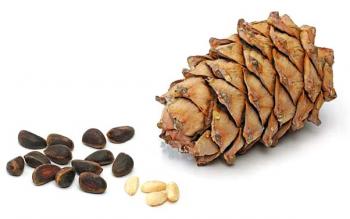
Siberian pine or, as it is commonly called in Russia, cedar, is one of the species of the genus Pine; an evergreen tree reaching 35–44 meters in height and 2 meters in trunk diameter. The maximum life expectancy is 500 (according to some sources 800-850) years. Cedar seeds ripen in cones and have a lot of useful and healing properties. The largest cedar cones produce up to 150 pine nuts. Siberian cedar is a long-liver; specimens as old as 200 years have been found. Cedar cones begin to ripen at the age of fifty. At the age of 45 - 100 years, the growth of Siberian pine slows down.
Cedar is most common in Western Siberia; it also grows in Eastern Siberia and the Urals. To the west of the Urals it extends only to the Timan Ridge. In Central Altai, the upper limit of the distribution of cedar lies at an altitude of 1900-2000 meters above sea level, and in the southern regions it rises to an altitude of 2400 meters. Siberian cedar also grows in Mongolia and Northern China. It is also found in the Sikhote-Alin mountains (along with Korean cedar).
In the European North of Russia there are plantings of Siberian cedar. These are old “pre-revolutionary” cedar groves: in the Arkhangelsk region these are Koryazhemskaya, Cherevkovskaya, Soezerskaya, Siyskaya and two Solovetsky ones; in the Vologda region - Chagrinskaya near Gryazovets, Kataevskaya and Petryaevskaya near Veliky Ustyug. In the 16th century, on the lands of the Tolgsky monastery near Yaroslavl, a grove of Siberian cedar with an area of one tithe was founded; about fifty trees are still alive and bear fruit abundantly. In 1957-1973, cedar was planted in the Ustyuzhensky special agricultural enterprise. Several hectares of cedar survived until the 60s and 70s of the 20th century in the east of the Kostroma region (Ponazyrevsky district), now only the last trees are included in the forest stand there.
Siberian cedar is often confused with Korean cedar, dwarf cedar and European cedar.
Pine nuts are a high-calorie product: per 100 g - 673 kcal. For comparison, the calorie content of lard is 840 kcal per 100 g.
100 grams of cedar kernels contain the daily share of amino acids, vitamins and microelements necessary for the human body. The digestibility of pine pine seeds exceeds the digestibility of bread, meat or vegetables.
Cedar seeds consist of 70% vegetable fats, while proteins and carbohydrates make up approximately 15% each. Cedar seed fat contains a significant amount of polyunsaturated fatty acids, especially linoleic acid.
Tinctures of pine pine seeds are used in the treatment of urolithiasis, gallstones and liver stones, and to cleanse the blood. The beneficial properties of pine nuts help to recover from bronchitis, gout, and metabolic disorders.
Pine nuts are a rich source of lecithin, which is necessary for the normal functioning of nerve cells and maintaining active brain activity. Cedar seeds are also often recommended for people with weakened immune systems.
The shell of a pine nut contains a lot of tannins. An aqueous infusion of cedar nut shells is useful for blood diseases, hemorrhoids, and stops internal bleeding. A decoction of the shell has an astringent, analgesic and anti-inflammatory effect, and is indicated for stomach or intestinal disorders, exacerbation of cholecystitis. For example, rinsing with a decoction of shells helps to cope with diseases of the oral cavity.
Cedar oil is highly digestible. The oil has no contraindications, with the exception of pregnancy, and it does not cause allergies. For the purpose of prevention, the beneficial properties of cedar nut oil are used to provide a general strengthening effect. In cases of runny nose, the oil can be dropped into the nose. Cedar oil is useful for many diseases, for example, in the treatment of gastritis, pancreatitis, cholecystitis, gastric and duodenal ulcers, etc. In case of diseases of internal organs, take 1 tsp of oil. an hour before meals. Pine nuts are useful for varicose veins. The oil is applied with light massage movements along the veins twice a day.