

Chaga
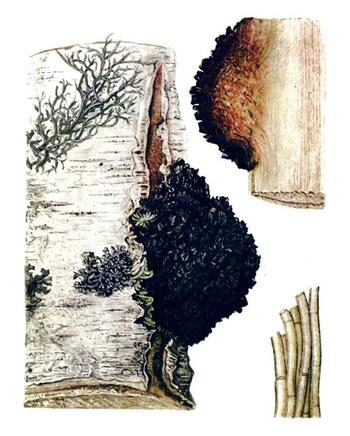
Chaga is an amazing creation of nature. Growing from a small spore to a huge size, the body of the fungus is saturated with useful substances thanks to birch sap and various components present in the tree on which it develops. Active components and microelements - such as, for example, potassium, zinc, iron, polysaccharides, etc. - are involved in all processes of human organs, when at least one of them is lacking in the body, a disease appears. You can replenish important nutrients by taking chaga mushroom products. This valuable natural medicine can treat intestinal and liver diseases and prevent cancer.
The birch mushroom belongs to the “mown tinder” species. Most often, the fungus affects birch, alder, rowan, elm, and maple. This sterile form of the fungus develops as a result of infection of a tree by spores of a parasitic fungus. The spores land on damaged areas of tree bark, contain oil, and when they mature, form comb-like growths riddled with veins consisting of colorless hyphae. The growths are irregular in shape, black in color, with a surface covered with many cracks.
Inside, the mushroom has a dark brown tint; closer to the wood, the flesh of the mushroom is reddish-brown.
The mushroom grows for 10–20 years, breaking through the bark, going deep into the table, and over time, the fruiting body of the mushroom appears on the opposite side of the trunk. The tree dies over time. Chaga spreads in birch groves and forests of Russia, in the taiga and forest-steppe. The mushroom can be seen on trees growing in the mountainous regions of North Carolina, the northern United States, and Korea. The mushroom has an irregular shape, it is harvested at any time of the year, taken from a living tree; it cannot be cut from dead trees and dead trees, since the activity of useful substances in such mushrooms is insignificant. It is best to store the mushroom dried, in a tightly sealed container; for this, large parts are crushed, since when the mushroom dries, it becomes hard.
Chaga larch is a tree mushroom; it consists of mycelium, which, penetrating tree trunks, forms a fruiting body. It lives for many years, has a hoof-shaped shape and weighs up to three kilograms. Larch chaga has a rough surface covered with bumps and a highly cracked crust. This mushroom grows on Siberian cedar and fir in the northeastern part of Russia, the Far East and Siberia. Only young white mushrooms are used for medicinal purposes. Chaga larch is a good remedy against profuse sweating in patients with tuberculosis. It also has laxative, hemostatic, sedative and hypnotic properties.
It is effective to take mushroom remedies for infectious diseases, Graves' disease, and neuralgia. A positive treatment result is achieved in the treatment of kidney diseases, dysfunctions of the liver, pancreas, and gall bladder. For bronchitis and/or colds, larch chaga acts as a fever reliever and a breathing aid.
Chaga has been used by people since ancient times to treat various ailments. It has antimicrobial and antiseptic properties. The substances included in its composition are real natural biogenic stimulants. Thanks to the organic acids contained in chaga, the unique mushroom has a therapeutic effect on the body, regulates and normalizes the ratio of hydrogen and hydroxyl ions in the body.
What are the benefits of chaga? Chaga mushroom is very valuable as a medicinal raw material. Taking decoctions and tinctures improves the condition of patients with tumors of any location, the body is saturated with vitamins, useful components help strengthen the immune system. In the initial stage of cancer development, chaga remedies inhibit the growth of cancer cells. The fruiting body of chaga contains oxalic, formic, acetic acids, polysaccharides, fiber, and resins, which improve appetite and eliminate pain. Sterols reduce the amount of cholesterol in the blood.
Chaga has anti-inflammatory and hemostatic properties; tannins, capable of folding protein, contribute to the formation of a protective film on the mucous surfaces of organs. The phytoncides, alkaloids, and flavonoids found in the mushroom make the mushroom useful as a diuretic and choleretic agent. Chaga contains iron, magnesium, manganese, and potassium. Regenerative processes in tissues occur due to the general strengthening and tonic properties of chaga.
Recovery occurs due to the action of melanin and microelements - copper, aluminum, silver, cobalt, zinc and nickel. The use of medicinal mushroom has a beneficial effect on the functioning of the central nervous system. There is a relief from exacerbation of chronic diseases and restoration of the functions of the gastrointestinal tract, and an increase in overall immune status.
The use of chaga mushroom helps prevent many diseases. Good results from treatment are obtained for joint diseases and decreased immunity. The mushroom is indicated for female and male diseases; many skin diseases are well treated.
When using chaga therapy, there are certain restrictions that must be strictly adhered to.
Restrictions:
- intravenous administration of glucose is unacceptable;
- Do not take chaga at the same time with antibiotics, especially those related to the penicillin series;
- direct contraindications to the use of chaga are chronic colitis and dysentery;
- it is necessary to monitor the diet, throughout the entire course you need to adhere to a vegetable and dairy diet, completely exclude animal fats, limit the consumption of canned food, spicy foods, smoked meats, and meat.