

Cinquefoil rhizomes
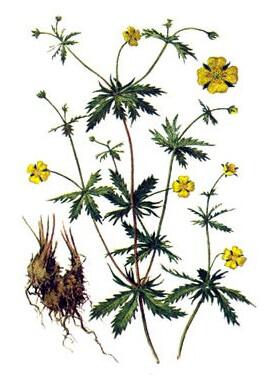
A perennial herbaceous plant up to 50 cm high. It has a thick woody rhizome, from which numerous small roots extend. The rhizome is light yellow when cut and reddish-brown outside. The stems are erect, branching at the top, the leaves are alternate, trifoliate or five-fingered, wedge-oblong in shape. Small yellow single flowers have a four-petalled corolla, which distinguishes them from other types of cinquefoils. Blooms from May to September.
Cinquefoil erecta - belongs to the Rosaceae family. The Rosaceae family includes about 115 genera and 3,000 species. The genus Potentilla includes up to 500 species of plants, distributed almost throughout the world, but mostly in temperate and cold regions of the Northern Hemisphere.
Potentilla erecta is a wild-growing perennial herbaceous plant, from 10 to 40 cm in height. The rhizome of cinquefoil is cylindrical or tuberous, thickened, multi-headed, woody, reddish-brown, and bears numerous adventitious roots. The stem is one or several, erect or ascending, forked-branched. The basal leaves are trifoliate or quintuple, long-petiolate. Stem leaves are sessile, trifoliate, large-serrate, with large stipules, appressed and hairy on both sides. Potentilla flowers are single, on long pedicels, about 1 cm in diameter. The corolla consists of 4 yellow, obovate petals. The plant blooms from mid-May to September. The fruit is a multi-nut, ripens in August and September.
Cinquefoil erecta grows in damp meadows, in sparse shrubs, on the edges of forests, and in clearings. Loves moist sandy, sandy loam, loamy and peaty soils. In the northern part of the range - in the tundra and forest-tundra it is found along the banks of rivers, streams, and along the outskirts of swamps.
In the European part of Russia it grows from the coast of the Barents Sea to the steppe zone, enters the southern taiga forests and forest-steppe of Western Siberia, grows in the Ciscaucasia, as well as in the mountain belts of the Greater and Lesser Caucasus. Found in Belarus and Ukraine.
The pharmacological properties of Potentilla erecta depend on the biologically active substances contained in the plant. Rhizomes contain up to 30% tannins, tormentilin glycoside; triterpenoids (up to 6%): quinovic acid, tormentoside; resins, crystalline tormenthol ether; phenolcarboxylic acids: gallic, quinic, ellagic, caffeic, n-coumaric, protocatechin, flavonoids (kaempferol), phlobaphenes; phenols (fluroglucinol, pyrocatechol, pyrogallol); catechin, wax, gum, starch, macro- and microelements.
A decoction of the rhizomes of Potentilla erecta has an astringent, anti-inflammatory, hemostatic, bactericidal effect, and also has an expectorant and choleretic effect.
It has been established that aqueous extracts from cinquefoil rhizomes have antimicrobial, antiprotozoal and fungicidal activity. The antimicrobial effect of the decoction when exposed to its chemical compounds on the intestinal microflora is unique. Its effect is milder and physiological, since the biologically active substances of the plant are essentially eubiotics and pathogenic pathogens do not develop resistance to them. A decoction of cinquefoil rhizomes is used in the treatment of diseases associated with functional intestinal disorders. This protects the inflamed intestinal mucosa from irritation and damage by microbial and other unfavorable agents, eliminates the acute inflammatory reaction, normalizes intestinal motor function, suppresses pathogenic intestinal flora and restores eubiosis in the intestine.
The general anti-inflammatory effect is associated with the action of flavonoids, and the local one is associated with tannins that can create a biological film that protects tissues from bacterial, chemical and mechanical effects that accompany inflammation, while at the same time reducing capillary permeability and constricting blood vessels.
In folk medicine it is due to the astringent anti-inflammatory, bactericidal and hemostatic properties of galangal. Recommended for inflammatory diseases of the stomach and intestines, accompanied by acute and chronic diarrhea, for various bleedings - pulmonary, gastrointestinal, gynecological.
Sometimes used for gout, rheumatism, acute and chronic liver diseases. It has some expectorant and choleretic effects.
Widely used externally in the form of compresses and lotions for bruises, weeping wounds and eczema, hemorrhoids, and poorly healing fissures. Cinquefoil is used in gynecology for douching, for leucorrhoea, and also for rinsing for diseases of the nasopharynx and oral mucosa.
Potentilla rhizomes are included in pharmaceutical antidiarrheal teas.