

Coriander fruit
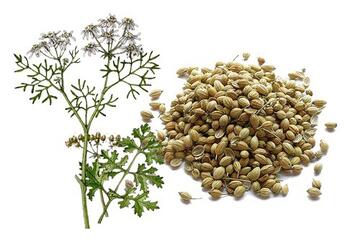
The leaves of coriander (cilantro) are used in cooking, and the fruits of the plant are used in medicine to increase appetite.
Coriander is used to treat low appetite, poor digestion, flatulence, diarrhea, and mild spasms of the digestive tract.
Coriander sativum belongs to the Apiaceae family. This species is cultivated in Russia.
Coriander sativum is a herbaceous annual plant 20-70 cm high with a thin spindle-shaped root. The stem is erect, round, finely grooved, glabrous, branched in the upper part. The leaves are alternate vaginal, with a characteristic peculiar odor. The basal leaves are long-petiolate, tripartite, incised-toothed along the edges, the middle and upper leaves are sessile, double- and triple-pinnately dissected. The inflorescence is a complex umbrella with three to five rays. The flowers are small, white or pink. Coriander blooms in June - July. The fruit is a spherical two-seeded seed with ribs of brown or grayish-yellow color with a diameter of 2–5 mm. The fruits ripen in August - September.
Coriander is native to northern Africa and Western Asia. It grows wild in southern Europe and Asia Minor. Cultivated in the central black earth and southeastern regions of the European part of Russia, Ukraine and the North Caucasus. In many countries, the plant has been cultivated to obtain medicinal raw materials: in Egypt, Romania, Morocco, India, Japan, China, and North America. As an alien and wild plant, it is found in the Caucasus, Crimea, Central Asia and the south of the European part of Russia.
Coriander fruits contain essential oil (0.7-1.5%), consisting of linalool (60-80%), geraniol (3-5%), cymene, geranyl acetate (up to 5%), borneol (1-4%) , their acetic acid esters and aldehydes: n-decyl, decylene and isodecylene (0.2-2.5%); terpenes, pinenes, phellandrenes. The fruits contain up to 20% fatty, non-drying oil, which contains fatty acid glycerides (92%) and unsaponifiable substances (up to 7.5%), and a small amount of alkaloids.
Coriander fruits are used as a bitter to increase appetite. They enhance the secretion of the glands of the gastrointestinal tract, have antispasmodic, carminative and laxative effects.
Coriander essential oil has choleretic, antihemorrhoidal, analgesic and antiseptic properties. When treating wounds, the plant stimulates tissue granulation.
Linalool, isolated from the essential oil of coriander, has a strong bactericidal and anthelmintic effect, and is used to obtain citral, used in ophthalmic practice for keratitis and conjunctivitis.
Coriander fruits are used in the manufacture of numerous herbal preparations that activate digestion and reduce flatulence, as an aromatic and taste-improving agent (aromatic waters, alcohols, syrups, teas).
Coriander is cultivated as an essential oil plant. It was grown as early as 1000 BC. e. in the Mediterranean. As a spicy and medicinal plant, coriander was bred in Egypt, India, and Palestine. The Greeks and Romans added coriander to food and wine and used it as a medicinal plant. Hieronymus Bock writes about medicinal use in 1540.
In domestic folk medicine, coriander seeds are used mainly for lung diseases (as an expectorant), diseases of the liver and gall bladder, stomach, intestines, as an anti-inflammatory, choleretic, carminative and analgesic. A decoction of the seeds is used for vomiting, tincture and infusion are used as a sedative and anticonvulsant, especially for hysteria.
The German National Health Service calls the area of application of coriander abdominal diseases - flatulence, mild spasms in the stomach and intestines.
Coriander is included in the British Pharmacopoeia. The fruits of the plant are included in various lozenges designed to flavor the breath of smokers.