

Fireweed
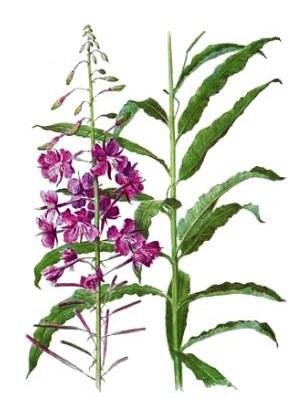
An aqueous infusion of fireweed leaves is used for headaches, metabolic disorders and stomach ulcers (the flowering tops are usually brewed and drunk as tea). Fresh crushed leaves applied to wounds promote rapid healing. A decoction of the leaves is used for scrofula, stomach diseases and as a sleeping pill for inflammation of the ear, nose and throat. The beneficial properties of fireweed tea are quite effective for prostate adenoma. Aqueous or alcoholic extract of fireweed prevents the inflammatory process and has a healing effect in acute and chronic prostate diseases, adenoma, inflammation of the ureters and chronic inflammation of the bladder, as well as as a supportive and absolutely harmless therapy after prostate surgery.
Ivan-tea angustifolia or fireweed angustifolia is one of the most famous species of the family Willowweed, or Aspenaceae. Ivan-tea is a representative of the genus, a species very widespread in temperate and subtropical regions. The generic name comes from the Greek. chamae – low (small) and nerion – the name of a subtropical oleander shrub. In everyday life, fireweed is usually called fireweed, although it is a separate genus (Epilobium), also belonging to the same family. However, the use of fireweed leaves as a tea substitute, i.e. surrogate and determined its name.
Perennial root sucker rather tall herbaceous plant 50-180 cm in height. It has a thick creeping rhizome up to 1 meter long, erect, cylindrical, few-branched, densely leafy bare stems 50-150 cm high. The leaves are very numerous on one shoot, alternate, entire, sessile, lanceolate, 5-12 cm long, 0.7- wide 2 cm, with sharply protruding veins, dark green above, bluish-green below. The flowers are 4-membered, large (about 3 cm in diameter), slightly zygomorphic, bright pink or lilac, purple, sometimes white with a deep four-parted calyx, a short tube and an irregular corolla. The inflorescence is a terminal sparse long raceme or spike, the flowers of which open from 6 to 7 am. Double perianth. The calyx is fused-leaved, the corolla is separate-petalled. The fruit is a long, pod-shaped (up to 5-9 cm) capsule, consisting of four valves, with numerous oblong-oval seeds, with a fluffy white tuft. It blooms from late July to mid-August, sometimes until September.
It is found almost throughout the entire territory of the European part of Russia. It grows among shrubs, in forests, especially abundantly light ones, in particular pine and birch, on the edges, clearings, wastelands and dried peat bogs, embankments along ditches and on roadsides. Ivan tea belongs to the so-called explerants, species that quickly occupy areas free of vegetation. It is the first among other plants to cover forest burnt areas and clearings with its flowers, forming continuous thickets over large areas. However, the territories occupied by it do not remain for long - they are inferior to other species. Prefers sandy soils, demanding light. Sometimes grown as an ornamental plant.
Leaves and roots of fireweed contain a large amount of tannins (up to 20%), mucus (up to 15%), flavonoids, pectins, alkaloids, ascorbic acid (up to 338 mg%, three times more than in orange fruits), sugar, organic acids, mineral salts (iron 23 mg%, manganese 16 mg%, boron 6 mg%, copper 2.3 mg%, nickel and titanium 1.3 mg% each, molybdenum 0.44 mg%). The roots of the plant have no tannins and contain less mucus.
Due to the content of tannins and mucus, fireweed leaves and roots have astringent, wound-healing, anti-inflammatory and enveloping properties. Whole fireweed leaves have significantly less anti-inflammatory activity than crushed leaves. This phenomenon is observed due to the combined effect of tannins and mucus. They also have calming (sedative), anticonvulsant, and analgesic effects. Fireweed preparations are low-toxic.
At first in Rus', tea was a rather expensive drink and was sometimes counterfeited in the village. Koporye, the former St. Petersburg province, earning a lot of money from this. Moreover, since the time of Catherine II, “Koporie tea” was most often made from fireweed leaves. The leaves were doused with boiling water and rolled. Their infusion had a pleasant taste, but of course it lacked the qualities of real tea.
“Ivan-tea” is an ancient Russian name that has survived to this day. Legend says that once upon a time there lived a boy named Ivan. He loved to wear a red shirt and spent most of his time among flowers. Local residents who saw the scarlet color flashing among the greenery said: “Yes, it’s Ivan, tea, walking.” And they got so used to it that they didn’t notice Ivan’s absence, and when scarlet flowers suddenly appeared at the outskirts of the village, they began to say: “Yes, this is Ivan-tea.” Since then, fireweed and the drink made from it have been called fireweed tea. Popular names for fireweed: fireweed, weeping, skrypnik, Koporsky tea, breadbox, miller, napkin, mother liquor and many others.
In the early 70s of the 20th century, a group of Russian specialists at the All-Russian Oncology Center of the Russian Academy of Medical Sciences obtained the drug hanerol. The raw materials for its production were fireweed inflorescences collected during the mass flowering phase. It was found that fireweed tea has pronounced cytostatic and hemagglutinating activity, which was confirmed by experimental studies. Hanerol has an antitumor effect. In terms of its spectrum of activity, it is closer to the group of antimetabolites, which, for example, includes the drug 5-fluorouracil. At the end of the 20th century, in the laboratory of preliminary testing of antiviral substances of the Belarusian Research Institute of Epidemiology and Microbiology, the antiviral activity of individual samples of plants and herbal mixtures growing in Belarus was studied. The ability of angustifolia fireweed to suppress the reproduction of the herpes simplex virus in tissue cultures has been established.