

Hawthorn flowers and fruits
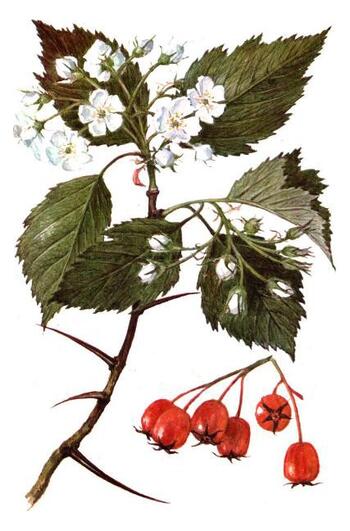
The plant is a centuries-old medicinal remedy used for palpitations, insomnia, and high blood pressure.
Hawthorn flowers and fruits are used for functional disorders of the heart, atrial fibrillation, paroxysmal tachycardia, myocarditis, atherosclerosis, obesity of the heart, vegetative dystonia, circulatory failure in the elderly, rheumatism, insomnia, hypertension and other diseases.
In dermatology, hawthorn is used for psoriasis, eczema, neurodermatitis, skin itching, in combination with other herbal remedies, especially in old age in the presence of concomitant diseases of the cardiovascular system; also with changes in lipid metabolism, including psoriatic polyarthritis. The use of hawthorn for atypical psoriasis is indicated.
The genus hawthorn belongs to the Rosaceae family. In the temperate climate of the northern hemisphere, there are up to 200 species of this plant. About 40 species of wild hawthorn grow in the forests of Russia. The following types are used for medicinal purposes:
- hawthorn blood red
- smoothed hawthorn
- hawthorn Korolkova
- yellow hawthorn
- Daurian hawthorn
- hawthorn
- German hawthorn
- hawthorn pentapalm
- Eastern Baltic hawthorn
- hawthorn reflexum sepals
- hawthorn Kurzeme
- hawthorn Daugava
Hawthorn is a shrub or small tree up to 4-5 m high with straight spines. The blood-red hawthorn is especially famous for its medicinal properties. It has strong purple-brown shiny shoots, usually bearing thick straight spines up to 2.5-4 cm long at the nodes. The leaves are alternate, short-petiolate, shallowly three-, seven-lobed or coarse-toothed to the middle, dark green above, lighter below, with both sides are short-haired, sharp, usually with a wedge-shaped base. On fruiting branches the leaves are 2-6 cm long, on barren ones - up to 9-10 cm, the width of the leaves is 2-8 cm. Along the edge (excluding the base) the leaves are serrated, the blades or teeth are sharp.
The flowers are white, with a peculiar smell, small, collected in corymbose inflorescences with a diameter of 4-5 cm, located mainly at the ends of the branches. The flower has 5 oblong-triangular sepals, bent outward. The corolla is five-petalled with a diameter of 12-15 mm, 20 stamens with purple anthers. The fruit is apple-shaped, 6-8 mm in diameter, with 3-4 (1-5) pitted seeds, visible through the rather transparent powdery pulp.
The fruits are blood-red, less often brownish, almost spherical, and have a sour-sweet taste. It blooms in May–June, the fruits ripen in August.
Blood-red hawthorn grows in sparse forests, forest edges, ravines, river banks, in the forest zone, in the forest-steppe and on the outskirts of the steppe zone. It is found in the east of the European part of Russia, in the south of Western and Eastern Siberia, in Eastern Kazakhstan.
Prickly hawthorn is not found in the wild in Russia, but is cultivated in the middle and southern zone.
Hawthorn pentapistillate is common in the Caucasus; it differs from other species in its black round fruits with a bluish bloom and less developed pulp.
All hawthorns are long-lived and live up to 300 years.
The beneficial properties of hawthorn are due to the biologically active substances contained in the plant. Research has shown that different types of hawthorn are very similar in chemical composition and physiological effect on the body.
Hawthorn fruits contain ursolic acid, oleanoic acid, β-sitosterol, chlorogenic and caffeic acids, saponins and flavonoids, triterpenoids (crategusic acid), vitamin C, carotene. In addition, hyperoside, hyperin, tannins, sorbitol, choline and fatty oil were found.
The seeds contain the glycoside amygdalin and fatty oil, the bark contains the glycoside esculin (krategin).
The leaves contain chlorogenic and caffeic acids, crategolic acid, and acantholic acid.
Flowers contain essential oil (up to 0.16%), tannins (up to 9%); flavonoids (acetylvitexin, vitexin, hyperoside, quercetin, pinnatifidine), organic acids (caffeic, chlorogenic, ursolic, oleanolic), acetylcholine, choline; macro- and microelements.
An infusion of hawthorn fruit has many beneficial properties. It has a cardiotonic, antispasmodic and moderate sedative effect, exhibits hypotensive properties and normalizes blood clotting. Hawthorn preparations calm the central nervous system, increase contraction of the heart muscle, regulate heartbeat, help normalize cholesterol levels in the blood, and increase blood circulation in the coronary vessels of the heart and brain vessels.
The cardiotonic effect of the plant is more pronounced when the heart is tired. By improving the functioning of the heart muscle, plant preparations in this case prevent its premature fatigue.
Infusions and extracts of hawthorn fruits and inflorescences have antispasmodic properties, selectively dilating coronary vessels and cerebral vessels. These medicinal properties of hawthorn allow the targeted use of plant preparations to improve the oxygen supply to the myocardium and neurons of the brain. The antispasmodic effect of hawthorn preparations is associated with the presence of triterpene compounds and flavonoids in the plant. The presence of these substances in the plant also determines the hypotensive effect of hawthorn preparations, as well as their effect on the level of venous pressure and improvement of the function of vascular cells.
When studying the effect of hawthorn herbal preparations and triterpene glycosides on lipid metabolism, it was found that they have a pronounced anti-atherosclerotic effect. Hawthorn preparations enhance the effect of cardiac glycosides.
The absence of any toxic effect with long-term use of hawthorn allows it to be prescribed even to patients with impaired renal function, without fear of cumulation.
As a cardiotonic and blood circulation regulating agent, hawthorn is recommended for circulatory failure in older people, especially with menopausal diseases, atherosclerosis and cardiac neuroses. Only after large doses (over 100 drops of hawthorn tincture) does the pulse slow down and some depression of the central nervous system occur.
Experimentally studied by D.Ya. Guseinov studied a drug called “crateponin” (saponino-flafin complex of hawthorn pentapistillate) at the Department of Faculty Therapy of the Azerbaijan Medical Institute; it was shown to be highly effective in atherosclerosis, expressed in lowering cholesterol levels in the blood and improving the functional capacity of the heart muscle (G.M. Jafarov).
The homeland of hawthorn is Western Europe. Popular names of the plant: bazarsha (Kyrgyzstan), emishan (Azerbaijan), tsrptkin (Armenia), kuneli (Georgia), tolone (Kalmykia).
The medicinal properties of hawthorn have been known for a long time. The plant has been used for medicinal purposes since the time of Dioscorides (1st century AD) as a remedy for the treatment of heart disease, insomnia, dizziness and shortness of breath.
Hawthorn has a centuries-old history of use in Chinese folk medicine. The fruits of the plant have been used for several centuries to enhance digestion for intestinal diseases, and in combination with wine for heart diseases. Hawthorn has been prescribed with great success for various neurotic disorders as a sedative.
Hawthorn inflorescences have long been used in North America, England and France for heart diseases. The scientific basis for the medicinal use of hawthorn preparations was given by English scientists at the end of the 19th century. Jening noted (1896) that hawthorn has a positive effect on heart disease, strengthens heart contractions and has a calming effect on the central nervous system. Doctor Clement achieved complete cessation of attacks of pain due to angina pectoris, using hawthorn in himself and in a large number of patients when other remedies did not provide relief. He believed that “the hawthorn is the most valuable discovery of the 19th century.”
The medicinal properties of the plant are widely used in folk medicine. An infusion of flowers and fruits is taken orally, especially for heart neurosis, hypertension, suffocation caused by heart ailments, a rush of blood to the head (“stroke”) and severe nervous shock.
In German folk medicine, water infusion and alcohol tincture of flowers and fruits are used for weak heart function in old age, palpitations, shortness of breath, increased nervous excitability, insomnia and general weakness of the body due to physical and mental fatigue.