

Large plantain leaves
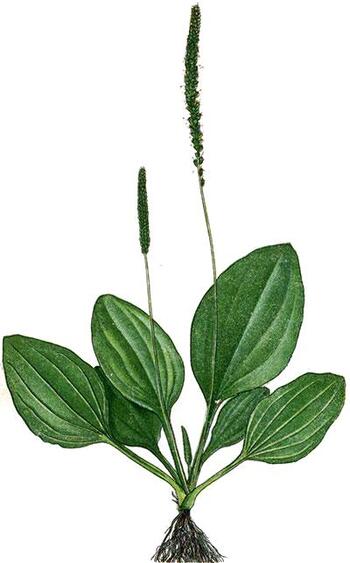
Perennial herbaceous plant. It has a small rhizome with thread-like roots extending from it. The stem is a leafless arrow up to 15-45 cm high. The leaves are collected in a basal rosette, entire, broadly oval in shape, with thick vascular-fibrous strands. Small brownish flowers at the end of the stems form inflorescences - spikelets. Blooms in June-August. The fruits are two-lobed capsules and ripen in August-October.
A characteristic feature is the ability of the plantain to constantly accompany a person (“plantago” translated from Latin – “foot”, “to lead”).
Plantain in our country is widespread everywhere except the Far North. It grows near housing, along roads, in clearings and meadows.
Plantain leaves contain the glycoside aucubin, flavonoids (homoplantaginin, plantaginin, derivatives of baicalein and scutelarein), tannins, bitterness, saponins, traces of alkaloids, vitamins C, K, carotene, as well as choline, adenine, pectin substances. The seeds contain mucilage (up to 44%), fatty oils, aucubin, oleanolic acid, steroidal saponins and carbohydrates, and protein substances.
Plantain has been used for medicinal purposes for a long time. Avicenna also used the leaves and seeds of the plant as a wound-healing and hemostatic agent.
In Chinese and Tibetan medicine, plantain is known as a wound-healing, diuretic, expectorant and hypoglycemic agent. The leaves and seeds of the plant, and preparations from plantain are sold in pharmacies. The leaves are harvested during the flowering of the plant and used fresh, dried, and the seeds are collected when ripe.
In folk medicine, plantain is used as a tonic, anti-inflammatory, emollient, soothing, expectorant, bactericidal, hypoglycemic, wound-healing, hemostatic agent; it has an antiallergic effect, is effective for diathesis, eczema, psoriasis, diabetic itching, and when diabetes mellitus is combined with allergic conditions.
Preparations of plantain activate digestive processes, increase appetite, and are useful for bloating, colitis, peptic ulcers of the stomach and duodenum, tumors of the stomach and intestines, and diseases of the gallbladder.
The juice of a fresh plant or a decoction of the seeds are active expectorants for coughs; they are drunk in combination with honey for bronchitis, bronchial asthma, tuberculosis, hemoptysis, lung cancer, whooping cough.
An infusion of fresh leaves acts as a tonic for fatigue, loss of strength, overwork, diabetes, anemia, hypertension, atherosclerosis, inflammation of the bladder, kidney disease, and bedwetting. Infusion and juice of fresh leaves are also used to relieve toxicosis during pregnancy, poisoning with heavy metal salts, and uterine bleeding.
Juice or decoction of the leaves has long been used in folk medicine to treat pustular skin diseases, boils, carbuncles, non-healing wounds, bruises, bedsores, and diabetic gangrene.
Lotions from the decoction or juice of a fresh plant are applied for skin diseases, including malignant ones, and for erysipelas. Plantain juice mixed with raw egg white is used to treat first and second degree burns.
A decoction of seeds is drunk for infertility, diabetes mellitus with infertility and decreased sexual function.
Juice and decoction of the leaves are used to rinse the mouth for periodontal disease, including diabetic disease.
Powder from plantain leaves is the basis of an ointment that is effective for eczema, allergic and pustular rashes, and for the treatment of purulent wounds.