

Licorice roots
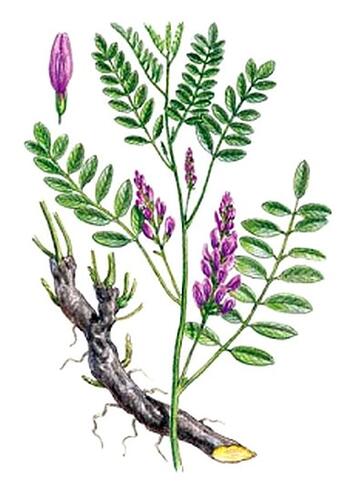
Perennial herbaceous plant. Grows on coastal pebbles, outcrops, foothills, old deposits, in small groups or singly.
The root is powerful, woody, and sweet in taste. Stem up to 1.2 m tall, weakly branched, glabrous. The leaves are petiolate, imparipinnate, with early falling lanceolate stipules and with 4-6 pairs of oblong-ovate leaflets with a wedge-shaped base and a short apex. The flowers are moth-like, up to 1 cm long, with a purple corolla and a calyx covered with pinpoint glands and scattered hairs, collected in an oblong inflorescence, up to 4 cm long, in the axils of the leaves. The fruit is a flat, elliptical shape with straight thin spines, a bean twisted into a dense spherical head, self-cracking when ripe. Blooms in July–August, bears fruit in September–October. Several species grow. All types have healing properties and can be used similarly for medicinal purposes.
It grows wild in the southeast of the European part of the country, in the Caucasus and Central Asia on river banks, along roads, on sand, as a weed in fields and vegetable gardens. Cultivated as a medicinal plant.
Licorice is recommended for introduction into culture to preserve the species. This plant needs protection.
Medicinal raw materials are rhizomes, aerial parts of the plant, leaves, and seeds. Roots are harvested at any time of the year, preferably in spring or autumn. They are chopped to a depth of 30-40 cm, crushed and dried at a temperature not exceeding 50°C in dryers. The above-ground part is collected during flowering, the fruits as they ripen.
All parts of the plant contain organic acids (glycyrrhizic acid and its potassium and calcium salts), flavone compounds, glycosides (liquirinite, liquiritigenin, liquiritoside), vitamins, essential oil, bitters, coumarins, etc. The sweet taste of licorice is given by saponin - glycyrrhizin (up to 23 %).
The roots of different types of licorice are included in all domestic pharmacopoeias and in many countries around the world.
Licorice preparations have expectorant, antispasmodic, anti-inflammatory, laxative, diuretic, antihistamine, and antitumor properties.
Galenic preparations of licorice are widely used in medical practice as an expectorant, enveloping, cough softener for diseases of the upper respiratory tract, with advanced inflammatory manifestations, especially in children and the elderly. They are used as an adjuvant therapy for Addison's disease, decreased function of the adrenal cortex, lupus, allergic dermatitis, and pemphigus.
Preparations of various types of licorice “Liquiriton” and “Flacarbin” are recommended as an anti-inflammatory, antispasmodic agent for gastritis, gastric and duodenal ulcers. "Glyciram" has a stimulating effect on the function of the adrenal cortex, changes the ratio of sodium and potassium ions in the blood, and has antiallergic properties. It is used for bronchial asthma, hypotensive syndrome of various origins, eczema, dermatitis. In France, Great Britain, and the USA, patented ointments, powders, and injection preparations of all types of licorice are used to treat rheumatism, asthma, dermatitis, diseases of the skin, eyes, ears, nose, and oral cavity.
Licorice preparations have antiviral, antispasmodic, anti-inflammatory properties, exhibit hypotensive, capillary-strengthening, antibacterial, expectorant, and antitumor effects; enveloping, mild laxative. It is used for various diseases: influenza, tuberculosis, diabetes, peptic ulcers, malignant tumors, diseases of the genitourinary system, as an antiviral; externally – for the treatment of psoriasis, eczema, lupus erythematosus, in cosmetics, for strengthening and growth of hair.
Licorice is contraindicated during pregnancy, hypertension, heart failure, and obesity.
Use in nutrition.
Licorice root extract is used in the food industry for making beer, lemonade, and kvass. Licorice is also used when soaking apples and making marshmallows.