

Lingonberry leaves
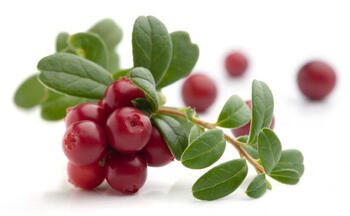
Common lingonberry is an evergreen shrub 5-25 cm high with a creeping rhizome. Belongs to the heather family. Lingonberry leaves are perennial, short-petioled, alternate, elliptical, dense, leathery, glabrous. The edge of the leaf is slightly curved towards the underside, the leaves are dark green, shiny above, paler and dull below, dotted with dark brown pointy glandular hairs of a club-shaped form. In winter, lingonberry leaves are under the snow. The flowers are small, with a white or pink pitcher-shaped corolla, collected in a two- to eight-flowered raceme. Lingonberries bloom in May–June. Fruits in August-September, starting from 10-15 years of age. Lives up to 300 years.
Lingonberry grows in coniferous and mixed forests, in mountain and lowland tundras, especially characteristic of pine and pine-spruce forests, found in grass glades, alpine meadows, and sometimes in swamps. Distributed throughout Russia, except for the southern regions and the Far East.
Various infusions of lingonberry leaves help with diseases of the kidneys, bladder and urinary tract, with gastroenteritis, putrefactive diarrhea, flatulence and chronic constipation, with diabetes, osteochondrosis, gastritis with reduced secretory function, with cholelithiasis. In dermatology – for eczema, neurodermatitis, psoriasis and other dermatoses.
Lingonberry leaves contain phenol glycosides: arbutin (up to 9%), methylarbutin, vaccinin, hydroquinone; organic acids (gallic, tartaric, ellagic, quinic, ursolic), flavonoids (quercitrin, isoquercitrin, kaempferol, rutin, avicularin, hyperin), tannins (2-17%, sometimes up to 32%), catechins, macro- and microelements.
The medicinal activity of lingonberries depends mainly on the phenolic compound arbutin, from which hydroquinone is cleaved in an alkaline environment, which has a strong antiseptic and diuretic effect. During treatment with lingonberry preparations, the urinary tract is cleared of bacterial flora and inflammatory products, residual nitrogen, urea, and creatinine are excreted along with urine, a general urine test is also normalized, and dysuria disappears.
The antiseptic properties of lingonberry leaves are also due to tannin compounds, which also have bactericidal and anti-inflammatory properties. Catechol substances reduce the permeability and fragility of capillaries.
The choleretic and disinfectant effects of the plant depend on arbutin. Arbutin and hydroquinone inhibit the growth of common pathogens of urological infections. Arbutin stimulates the process of epithelization in the kidneys and has a hypoglycemic effect.
The active substances of lingonberry leaves increase the effectiveness of antibiotics, stimulate phagocytosis and other body defenses. Leaf phytoncides inhibit the growth of Staphylococcus aureus.
Lingonberry leaf is a complete substitute for scarce bearberry leaves, and due to the lower content of tannins, infusions of lingonberry leaves have a stronger diuretic effect than bearberry infusions.
In folk medicine, lingonberry leaves are used in pure form and in the form of preparations for acute and chronic diseases of the urinary tract, kidney stones and gall bladder, and bedwetting in children. Lingonberries are also used to treat inflammatory diseases of the liver, gastrointestinal tract (hypoacid gastritis, gastroenteritis, putrefactive diarrhea, chronic constipation, flatulence), rheumatism, nonspecific arthritis, gout, osteochondrosis.
In Germany, inflammation of the bladder is treated with decoction and infusion of lingonberry leaves. Austrian folk medicine uses lingonberry leaves as an anti-inflammatory, bactericidal and diuretic agent. In Poland, lingonberries are used as an anti-inflammatory, bactericidal and diuretic agent. In Ukraine, lingonberry water with honey is used for tuberculosis, especially for hemoptysis.