

Marigold flowers
A plant loved by many and often found in flower beds. In medicine it is used as an antiseptic and anti-inflammatory agent.
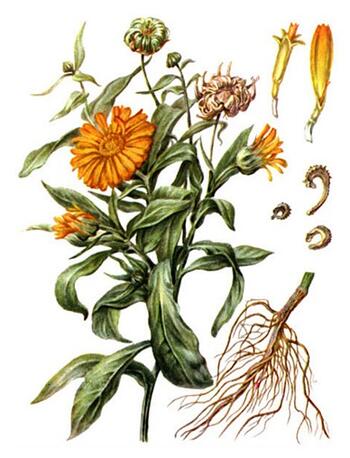
Family Asteraceae. An annual herbaceous plant with a weakly branched tap root, up to 40–60 cm high. The leaves are obovate, alternate, light green in color. Orange-yellow beautiful large flowers are located on the tops of the stems and lateral shoots, collected in baskets. It blooms in June–August, the fruits ripen in July–September.
Marigolds (calendula officinalis) belong to the Asteraceae family. The marigold genus includes up to 20 plant species.
Calendula officinalis (marigold) is an annual herbaceous plant up to 50-60 cm high with a specific aroma. The root is taproot, branched. The stem is erect, branched, and covered with glandular hairs in the upper part. The leaves are alternate, light green, covered with hairs; the lower ones are petiolate, obovate, elongated, the upper ones are sessile, lanceolate. The flowers are golden yellow or orange, collected in large (4-7 cm in diameter) apical baskets. Marginal flowers are ligulate, pistillate. The middle ones are tubular, five-toothed, with an underdeveloped pistil and five stamens. Blooms from June until autumn frosts. The fruits are arched, warty achenes arranged in 2-3 rows and ripen in July.
In the wild, calendula officinalis (marigold) is found in the Mediterranean countries of Europe, Africa and Asia, spreading to the Middle East to Iran. Some botanists believe that Calendula officinalis (Marigold) is an old natural hybrid of Calendula subshrub, native to Southern Europe, and Calendula stellata, native to Africa.
Marigolds are cultivated in many European countries (Germany, Austria, Hungary, Poland), including Russia, Ukraine, Belarus, as well as in the USA and Central Asia.
It is grown for medicinal purposes in the southern regions of the European part of the country, in the Caucasus, as well as in the Moscow region. It is popular among floriculture lovers, as an ornamental plant found in gardens and parks throughout Russia.
Triterpene saponins, bitterness, tannins, mucus, essential oils, phytoncides, large amounts of carotene and carotenoids, flavonoids and alkaloids were found in various parts of the plant.
The flower baskets of medicinal marigolds contain carotenoids (up to 3%) - carotene, rubixanthin, lycopene, citroxanthin, violoxanthin, flavochrome, flavoxanthin, etc. (15 compounds).
Marigold varieties with dark orange reed flowers contain almost 10 times more carotenoids than varieties with yellow reed flowers.
Also found in marigold flowers are paraffin hydrocarbons (gentriacontane and sitosterol), resins, triterpene glycosides, mucous and bitter substances, organic acids (malic, salicylic), and ascorbic acid. Triterpene saponins—oleanolic acid glycosides, called calendulosides A, B, C, D, E, F, G, H—were identified in marigold extracts.
The content of the sum of oleanolic acid glycosides in the roots and aerial parts of medicinal marigolds ranges from 4 to 5%. Eight flavonoids (rhamnetin, isorhamnetin-3-glucoside, isoquercitrin, etc.) were identified in marigold inflorescences. Their number varies depending on the variety and population in the range of 0.26–0.91%, and varieties with double orange inflorescences are rich in flavonoids.
Triterpene compounds are present in marigold flowers and other plant organs: alcohols (up to 5%) and oleanolic acid. A polysaccharide was isolated from the inflorescences of the plant, which includes arabinose, galactose, glucose, rhamnose and xylose.
Marigold inflorescences contain 0.05–0.2% essential oil, and there is more of it in the receptacle (up to 0.4%) than in reed flowers (up to 0.12%). In addition, a small amount of coumarins (scopoletin, umbeliferon and esculetin), resinous (up to 3.44%) and tannins, mucus (up to 2.5%), traces of alkaloids and trace elements were found in the inflorescences of the plant.
All organs of marigolds contain sterols, especially a lot of them in the leaves (up to 18%). Tocopherols and calenden bitterness have been isolated from the leaves of the plant.
An infusion of marigold flowers has anti-inflammatory, antiseptic and choleretic effects. The phytoncidal properties of the infusion are due to the essential oil of the plant. Despite the fact that the bactericidal effect of the plant in relation to streptococci and staphylococci is insignificantly expressed, in general, inflammatory processes complicated by bacterial flora proceed more favorably under the action of marigold preparations, apparently due to increased growth of granulations, improved epithelization and increased local protective mechanisms.
Calendula (marigold) flowers have antispasmodic properties. By relaxing the smooth muscle structures of organs such as the stomach, intestines and liver, the plant also stimulates secretory activity, which enhances bile formation and bile secretion and increases the secretory activity of the stomach.
Marigold flowers are used as an external rinse in dentistry for diseases of the oral cavity (stomatitis, gingivitis, periodontitis, thrush in children, pyorrhea, inflammatory-dystrophic form of periodontal disease). In gastroenterology, marigolds are used for gastritis, gastric and duodenal ulcers, colitis, enterocolitis, and liver diseases. In gynecology - in the form of douches for the treatment of cervical erosions and Trichomonas colpitis.
Also, infusion of marigolds is used in the form of rinses in the treatment of tonsillitis, and in combination with sulfonamide drugs and antibiotics - for the treatment of sore throats; in the form of enemas - in the treatment of proctitis and paraproctitis.
Tinctures, ointments, emulsions, and fresh plant juice are used externally for minor wounds, cuts, bruises, burns, furunculosis, and blepharitis. Medicinal marigold flowers are included in many herbs and dietary supplements.
Widely used in folk and scientific medicine. Calendula calms the nervous system, slightly lowers blood pressure, enhances heart activity and slows down the heart rate. It is used for neuroses, hypertension, angina pectoris, atherosclerosis and menopause.
Calendula herb has a pronounced bactericidal effect against streptococci, staphylococci, etc.
It is used in the treatment of gastritis, gastric and duodenal ulcers, kidney and biliary tract diseases, jaundice, pancreatitis, kidney and bladder stones, and ulcerative colitis. In folk medicine it is considered an antitumor agent.
Calendula is especially widely used externally: for diseases of the oral cavity and pharynx, for wounds, abrasions and trophic ulcers. Flowers are effective in gynecological practice for douching for erosions, leucorrhoea and trichomonas colpitis. It is recommended as an anti-inflammatory for eye diseases.