

Marshmallow root extract
Preparations of marshmallow are used for coughs, for diseases of the respiratory system with chronic bronchitis, tracheitis, laryngitis; whooping cough, acute respiratory diseases, bronchopneumonia and bronchial asthma. In gastroenterology, marshmallow is used for gastritis and peptic ulcers of the stomach and duodenum, with increased acidity of gastric juice. In dermatology, marshmallow is used for eczema, vesicular dermatoses, psoriasis, rosacea in the form of applications, for ulcerative and erosive processes in the oral cavity, burns, seborrheic dermatitis of the face, inflammatory and conglobate acne, etc. The roots of marshmallow are included in the composition of the preparations.
Althaea officinalis belongs to the malvaceae family, which includes 85 genera, distributed mainly in the tropics and subtropics, and relatively few in temperate regions. The marshmallow genus includes about 12 species of plants growing in the temperate zone of Europe and Asia, of which 8 are found in the CIS.
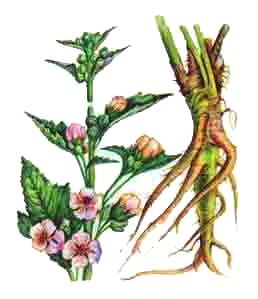
Marshmallow is a perennial densely pubescent plant due to the presence of star-shaped branched hairs, has one or more stems and a strong branched short rhizome with rather thick, long fleshy roots. The stems are mostly erect, simple, sometimes branched in the upper part, from 50 to 150 cm high. The leaves are alternate, depending on their placement on the stem they have a different shape of the leaf blade.
The upper leaves are long-petiolate, ovate, pointed, irregularly tubular-toothed at the edges, ovate-oblong, three-lobed with an elongated middle blade, and broadly wedge-shaped at the base; the middle leaves are slightly rounded or almost flat at the base; the lower leaves are larger and wider than the others, three- or five-lobed, sometimes heart-shaped at the base. All marshmallow leaves are grayish-green in color and pubescent. Marshmallow flowers are located on peduncles, crowded at the top of the stem and placed on common peduncles emerging from the axils of the upper and middle leaves, with a subcup characteristic of plants of the mallow family; sepals broadly ovate, hairy, pointed. The corolla is pale pink, not very open, consists of 5 petals; The petals are broadly ovate, deeply notched at the apex, narrowed near the base. The fruits are small, disc-shaped aggregate achenes, wrapped in a cup, pubescent with short hairs, up to 7-10 mm in diameter. The seeds are dark brown, smooth, kidney-shaped, 2-2.5 mm long. The plant blooms in summer from June to August, the fruits ripen from July.
Althaea grows throughout almost all of Europe, with the exception of the northern regions of the Scandinavian countries and Scotland. It is also found in North Africa, Iran, Afghanistan, Asia Minor and northwestern China and Mongolia. Widely distributed throughout the European part of Russia, reaching the North Caucasus, the plant is also found in the south of Western Siberia, in Kazakhstan, in the lowlands of Altai, in individual desert oases and in non-desert regions of Central Asian countries. As a weed, marshmallow is introduced to North America.
Marshmallow belongs to plants containing mucilage; therefore, in the phytochemical aspect, the polysaccharides of marshmallow roots are the most well studied. It was found that marshmallow roots contain 30 to 35% mucilage. In 1912, monosaccharides - D-glucose and DL-xylose - were identified in the mucus of the plant, and in 1946, uronic acids, methylpentoses and hexoses were discovered. Dry mucus contains from 19.52 to 21.68% reducing polysaccharides in terms of glucose. In addition to mucilage, the roots of marshmallow contain from 5 to 11% of the linear polysaccharide triticin and up to 78% of invert sugars, tannins (from 4.11 to 7.96%), essential amino acids, in particular asparagine (from 0.8 to 2% ) and betaine (up to 4%); starch (37%), pectin (11-20%), fat (2%), organic acids, carotene.
Marshmallow has an expectorant, enveloping, anti-inflammatory and mild analgesic effect, which is due to the high content of heterogeneous mucus. In modern pharmacological nomenclature, marshmallow root belongs to the group of antitussives. A mucous decoction of marshmallow root, flowing down the back wall of the pharynx, moistens the vocal cords, penetrates the trachea, softening dense plaque, protects the nerve endings of the mucous membranes of the pharynx and trachea from irritating factors and accelerates the healing of affected areas of the mucous membrane. In addition, due to its colloidal properties, mucus facilitates expectoration.
When used together with other more active anti-inflammatory drugs, marshmallow root mucus has the ability to slow down their evacuation, thereby facilitating a longer and more complete effect of other medications on the affected areas.
An aqueous extract of marshmallow root, taken orally, also has an enveloping effect on the gastric mucosa. The effectiveness of the enveloping effect increases with increased acidity of gastric juice, since when interacting with hydrochloric acid, the viscosity of mucus increases. Plant mucilage from marshmallow root and colloidal aqueous solutions envelop the mucous membranes of organs with a thin layer for a long time, protecting them from further irritation by harmful factors, in particular cold or dry air, chemical irritants, preventing them from drying out and creating favorable conditions for healing. Mucus is able to adsorb and inactivate toxins of bacteria and viruses, toxic products that damage epithelial cells, and prevents contact of toxins with the mucous membrane. As a result of the action of mucus, spontaneous regeneration of damaged tissues decreases and the intensity of the inflammatory process decreases.
For medical purposes, infusions, decoctions, dry and liquid root extracts, and marshmallow syrup are used.