

Motherwort
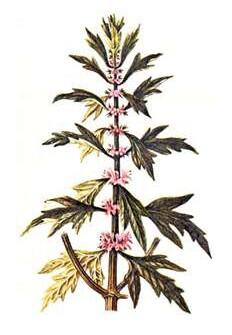
A widespread herbaceous plant with a sedative effect.
Motherwort preparations are prescribed for increased nervous excitability, cardiovascular neuroses, sleep disorders, neurocirculatory dystonia, in the early stages of hypertension, after influenza and other infectious diseases, for cardiosclerosis, angina pectoris, myocarditis and myocarditrophy, heart defects and Graves' disease, hypersthenic neurasthenia type, hysteria, epilepsy, algodismenorrhea, menopausal syndrome.
In dermatology, it is used for neurodermatitis, eczema, itchy skin, lichen planus, psoriasis, mainly as a sedative, also for childhood and microbial eczema with functional disorders of the nervous system.
Motherwort herb is included in sedative preparations.
About 15 species of motherwort grow in the temperate zone of Eurasia; 9 species are found in Russia. The genus motherwort belongs to the Lamiaceae family (lat. Lamiaceae). Two types of motherwort are widely used in medicine:
- motherwort five-lobed
- motherwort (common)
Motherwort pentaloba is a perennial herbaceous plant with a height of 50-150 cm (200 cm). Has one or more stems. The stem is erect, tetrahedral, branched, with short curly hairs along the ribs. The leaves are petiolate, opposite, bright green, grayish below, covered with hairs. The lower leaves are palmately five-lobed up to the middle of the leaf, the upper leaves are three-lobed. The flowers are pink, collected in dense false whorls in the axils of the upper leaves. The plant blooms from June to September. The fruits are four-nutty.
Motherwort cordial is a perennial herbaceous plant up to 150 cm high. The stem is erect, tetrahedral. The leaves are petiolate, opposite, dark green, covered with small dense hairs. The lower ones are round or ovoid, palmately five-parted up to the middle of the leaf, the upper ones are simpler. The flowers are pale pink, collected in dense false whorls in the axils of the upper leaves. The plant blooms from June to September. The fruits are four-nutty.
Motherwort five-lobed grows on loamy and sandy loam soils along the edges, clearings in coniferous and mixed forests. The plant is found in vacant lots and weedy places. Distributed in the European part of Russia, except for the Far North, it is found in the Caucasus, Western Siberia, Belarus, Ukraine, and Central Asia.
Motherwort cordial grows in weedy places, abandoned parks, gardens, near fences, among bushes, near homes. Widely distributed throughout the European territory of Russia and Western Siberia, except for the Far North, in the Baltic states, Belarus, and the Black Sea region.
The main active ingredients of motherwort herb are flavonoids, iridoids and alkaloids.
The plant contains alkaloids (up to 0.4%): leonurine, leonuridine, stachidrine; choline; sapononins, flavonoids: quercetin, rutin, quinqueloside, cosmosiin, hyperoside, quercetin, quercetin-7-glucoside, isoquercetin; iridoids: galiridoside, 8-acetylharpagide, ayugoside, ayugol, harpagide; essential oil (up to 0.9%), which includes limonene, linalool, caryophyllene, α-humulene, α- and β-pinene; diterpenoids, steroid glycosides, caffeic acid glycoside, paracoumaric acid, tannins (up to 2.5%), marubin bitterness, coloring matter, resins, vitamin C, carotene; macro- and microelements.
Motherwort herb has pronounced sedative (calming) properties. Plant preparations have antispasmodic and anticonvulsant effects, slow down the rhythm and increase the force of heart contractions, and have a pronounced hypotensive and cardiotonic effect. Motherwort has a beneficial effect on carbohydrate and fat metabolism, reduces the level of glucose, lactic and pyruvic acids, cholesterol, total lipids in the blood, and normalizes protein metabolism.
For heart failure, motherwort reduces swelling, increasing urination; for hypertension, it lowers blood pressure, reduces headaches, improves sleep and overall well-being.
Motherwort tincture is used as a sedative for increased nervous excitability, in the early stages of hypertension, and sleep disorders.
Iridoids have different properties: immunostimulating, choleretic, laxative, antimicrobial, fungicidal, antitumor, etc., but primarily sedative, therefore they are considered as a class of natural compounds for the creation of new medicinal products of plant origin. Plant iridoids increase the effectiveness of complex therapy of arterial hypertension, accompanied by psycho-emotional disorders, and make it possible to reduce doses of antihypertensive drugs.
The antispasmodic activity of motherwort herb is due to the action of flavonoids and iridoids. The bitterness and flavonoids of the plant improve digestion and have a choleretic effect; triterpenes exhibit cardiotonic properties, anti-atherosclerotic activity, and enhance the effect of cardiac glycosides.
According to a number of authors, motherwort tincture depresses some functions of the central nervous system 2-3 times more strongly than valerian tincture. In this regard, motherwort preparations in some cases are more effective than valerian. Also, motherwort tincture (due to rutin) had a more pronounced antioxidant effect compared to hawthorn tincture.
When taking motherwort preparations, the therapeutic effect occurs rather slowly, so the dose is selected individually, taking into account the clinical picture of the disease.