

Oregano herb
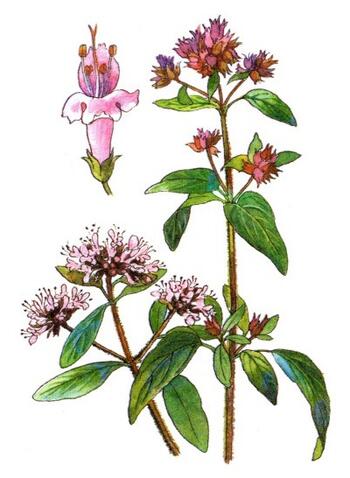
A perennial herbaceous plant with a pleasant aroma. Has expectorant, choleretic and other medicinal properties
Oregano is a perennial herbaceous plant 30-90 cm high. The leaves are petiolate, opposite, oblong-ovate, pointed at the apex, finely toothed or almost entire, 2-4 cm long, dark green above, grayish-green below. Stems are tetrahedral, softly pubescent or almost glabrous, often branched at the base.
Inflorescences in the form of a corymbose panicle, spreading multi-flowered. The flowers are small, numerous, 3-5 mm long, pinkish-purple. The plant blooms from July to September, the fruits ripen from August. Oregano flower formula: ↑Х(5)Л(2+3)Т4П(2). The fruit consists of four dark brown nuts, 0.5 mm long.
It grows on forest edges and clearings, in sparse deciduous and coniferous forests, among thickets of bushes, on the slopes of ravines, along roadsides, sometimes in shelterbelts and gardens in small, usually sparse groups.
It grows throughout almost the entire territory of the European part of the CIS (except for the Far North), in the south of Siberia to Transbaikalia, in the mountainous regions of Central Asia, the Caucasus, Ukraine, Belarus, and less commonly in Kazakhstan and Kyrgyzstan.
Essential oil (up to 1.2%) was found in the oregano herb, the main components of which are thymol (up to 40%), cymene, carvacrol, sesquiterpenes, geranyl acetate, selinene, α-thujone, α-terpinene. In addition, the plant contains flavonoids: apigenin, luteolin, 7-glucuronide, luteolin-7-glucoside, isoroifolin, cosmosin; ascorbic acid and tannins (up to 19%), macro- and microelements, the seeds contain fatty oil (up to 28%).
Oregano herb has an expectorant, choleretic, diuretic and sedative effect, and has a calming effect on the central nervous system. Oregano essential oil enhances the secretion of digestive and bronchial glands, stimulates peristalsis and improves intestinal tone.
High antibacterial activity of aqueous extracts and alcoholic tinctures from oregano has been established. Thymol in the essential oil of the plant causes a moderate antimicrobial and antiviral effect. Therefore, oregano herb is appropriate to use to combat pathogenic microorganisms.
Ancient doctors used the herb oregano, calling it “oregan”. This plant is mentioned in the works of Dioscorides, Aristotle, and Aristophanes.
In folk medicine, oregano is used as an expectorant, diaphoretic for colds, inflammatory diseases of the throat, in case of insufficient formation of gastric juice, as an anti-inflammatory, diuretic, and hemostatic agent.
For many centuries, oregano has served as a sedative and mild sleep aid, especially in children's practice. An infusion of the herb is used to alleviate the painful condition of children in infancy and menopausal women, which gave rise to the popular name of the plant - motherwort.
Oregano is used to increase the secretion of bile, for intestinal and stomach cramps, vomiting, headaches, and irregular menstruation.
The medicinal properties of oregano were used for nervous disorders and epilepsy in the form of an infusion.
In Russian folk medicine, oregano is used for choking and colds. An infusion of the herb was taken internally and externally “for impurities and rashes on the body,” for scrofula and as a means for hair growth. Villagers love to drink oregano tea, especially during field work. For migraines and insomnia, wash your hair with oregano infusion. Oregano herb is used to prepare baths for children suffering from diathesis and pruritus.
As a resolving agent, compresses of fresh or dry leaves soaked in boiling water are used, which are applied to skin infiltrates.
Oregano is useful in cosmetology . An infusion of oregano herb is used for oily and combination skin prone to excess sebum secretion, acne and pimples. Regular washing with the infusion of the plant makes the skin cleaner, matte and fresh.
Oregano essential oil is used in perfumery to flavor toilet soaps, colognes, and lotions.