

Pharmaceutical camomile
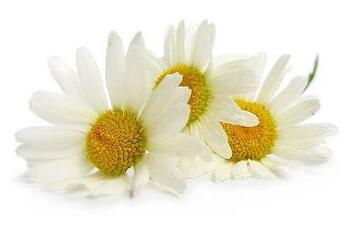
One of the most popular medicinal plants with a wide spectrum of action.
Family Asteraceae. An annual herbaceous plant with a grooved, highly branched stem up to 40 cm high. The leaves are alternate, pinnately dissected, sessile. Flowers with white marginal flowers and yellow middle ones are collected in baskets. A special feature of medicinal chamomile (in contrast to odorous chamomile, non-odorous chamomile and nivaria) is the conical hollow receptacle of the baskets. Blooms in May–July. The fruits are achenes and ripen in June–August.
Chamomile is an annual herbaceous plant up to 60 cm tall. The root is taproot, weakly branched, the stems are solitary, sometimes branched from the base, ribbed, glabrous, leafy to the top. Leaves are alternate, 2-5 cm long, sessile, twice or thrice pinnately dissected into linear subulate-pointed segments, lower leaves with a semi-stem-encompassing base. The baskets are hemispherical, 15-20 mm in diameter, with white marginal false-lingulate and yellow inner tubular flowers. The inflorescence bed is conical, hollow, bare, lengthening towards the end of flowering. The involucre of the baskets consists of elongated, blunt leaves that are arranged in rows like tiles. Chamomile blooms all summer. The fruit is a curved achene, narrowed at the base, 1-2 mm long, with 5 ribs on the inner side.
Chamomile belongs to the Asteraceae family. The chamomile genus includes about 50 species native to Eurasia and Africa. As a medicinal plant, it is cultivated in the southern regions of Ukraine and in the middle zone of the European part of the country. It grows wild in fields, along roads, as a weed in gardens and orchards throughout most of Russia.
Flower baskets collected at the beginning of flowering.
Chamomile inflorescences contain essential oil, the main active principle of which is chamazulene; flavonoids, organic acids, lactones, coumarins, terpenes, sesquiterpenes, alcohols, vitamins, bitters and gums were also found.
It has a sedative effect on the nervous system, has an anti-inflammatory, antiseptic, hemostatic, analgesic, carminative, diaphoretic, choleretic, astringent, laxative and antiallergic effect.
An infusion of chamomile flowers is used orally in complex therapy for chronic gastritis, gastric and duodenal ulcers, diseases of the liver and biliary tract, chronic enteritis, chronic colitis, flatulence, intestinal spasms, diarrhea; locally – for diseases of the ENT organs (pharyngitis, tonsillitis, tonsillitis); for spastic colitis, hemorrhoids, painful menstruation. In dentistry, chamomile infusion is used for diseases of the oral cavity (stomatitis, gingivitis, etc.).
In dermatology, chamomile is used internally for eczema, neurodermatitis, urticaria, prurigo, lichen planus, and externally for the treatment of poorly healing wounds and allergic itchy dermatoses. Chamomile chamazulene is used for bronchial asthma, rheumatism, and radiation burns.
Chamomile flowers are included in many domestic herbs and dietary supplements.
Chamomile has anti-inflammatory, antispasmodic and moderate antimicrobial effects, reduces fermentation processes in the intestines, and increases the secretion of digestive glands.
Chamomile essential oil improves the function of the gastrointestinal tract. Flavonoids have an antispasmodic effect on the smooth muscles of the bile ducts, intestines, blood vessels and ureters, increase the outflow of bile, prevent stagnation of bile in the gallbladder and thereby prevent the possibility of stone formation, facilitate bile secretion into the duodenum as a result of reducing spasm of the sphincter of the hepatic-pancreatic ampulla, They also relieve spasms of the large and small intestines, restore normal peristalsis, thereby improving the digestive ability of the gastrointestinal tract, and stimulate appetite.
The soft enveloping properties of chamomile are to a certain extent due to mucus, which has a high absorption capacity, as a result of which it adsorbs various poisons. By covering the inflamed tissue, it prevents heat transfer and acts as a warming compress. Also, mucous substances protect the tissue from external irritants and accordingly reduce its sensitivity. This reduces pain and relieves spasms of the gastrointestinal tract, i.e. normal working conditions are created.
Chamomile is an intestinal eubiotic. Chamomile infusion and decoction exhibit antimicrobial, antiviral, and fungistatic effects, which served as the basis for the use of chamomile preparations in the fight against pathogenic microorganisms. Moreover, pathogenic pathogens do not develop resistance to the herbal preparation.
For diseases of the liver and biliary tract, chamomile preparations relieve spasms of the bile ducts, increase bile secretion, and reduce inflammation.
When treating diseases of the gastrointestinal tract with chamomile in combination with calendula and yarrow, better results are observed than with monotherapy. At the same time, pain, belching, and flatulence disappear in patients, and their general well-being improves. The complex use of these plants enhances their anti-inflammatory, antispasmodic, and wound-healing effects, and yarrow, in addition, increases blood clotting and has vasodilating and analgesic properties.
Prescribed for diseases of the nervous system: neuroses, hysteria, chorea, epilepsy, trigeminal neuralgia, as well as painful menstruation and dysmenorrhea.
Chamomile is used as a mild emollient and expectorant for respiratory diseases. Acts as an effective remedy for diseases of the gastrointestinal tract and liver: gastritis, peptic ulcers, enterocolitis, ulcerative colitis, cholecystitis and hepatitis, spastic pain and flatulence.
Chamomile as a component of medicinal preparations is prescribed for diseases of the kidneys and bladder, as well as for childhood diathesis.
Infusions are used as an external remedy for lotions, douches, poultices, compresses and baths. Chamomile is used to gargle the throat and mouth for sore throats, stomatitis, and dental diseases. It is prescribed for eczema, abscesses and burns.
Chamomile is used in cosmetics; its decoction is used to rinse hair after washing.
The pharmacological properties of chamomile depend on the biologically active substances contained in the plant. Chamomile inflorescences contain essential oil (0.2 - 0.8%), consisting of the main biologically active substance - chamazulene, its precursor - prochamazulene and other monoterpenes and sesquiterpenes; flavonoids, derivatives of apigenin, luteolin, quercetin, kaempferol, isorhamnetin; coumarins, sesquiterpene lactones: matricin, matricarine, phytosterols, phenolcarboxylic acids, choline, organic acids (isovaleric, salicylic, caprylic), vitamin C, carotene, gums, mucus, bitterness, polyacetylenes, macro- and microelements.