

Rhodiola rosea rhizomes and roots
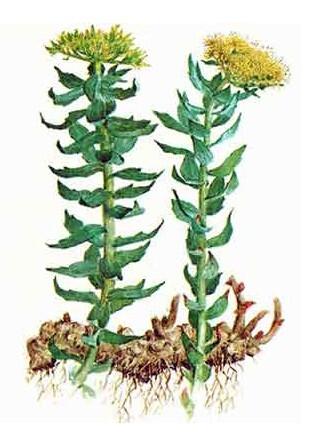
Rhodiola rosea is a perennial herbaceous plant with a thick rhizome that turns into a fleshy root. The rhizome is covered with exfoliating bark of a bronze-brownish-gray color. The stems are straight, not branched, from 25 to 65 cm high, covered with scale-like leaves at the base. The leaves of the stem are green, alternate, sessile, elliptical or oblong.
Rhodiola fruits have reddish or yellow-green leaflets. Flowering in June-August, fruits ripen in July-September. Propagated by seeds and pieces of rhizomes.
It grows in the polar-arctic and alpine regions, in Altai, in the Kuznetsk Alatau mountains, in the Urals, in the Irkutsk region, Transbaikalia, and on the Chukotka Peninsula. It grows under natural conditions in the north of the European part of Russia and in Siberia. In the middle zone it is successfully grown as a medicinal plant in suburban areas.
Rhizomes and roots of Rhodiola rosea are used for neuroses. Preparations based on them normalize the processes of the nervous system and improve sleep. The extract of rhizomes of Rhodiola rosea, produced by the pharmaceutical industry, is superior in effectiveness to many stimulants, for example from Schisandra, Eleutherococcus, and Aralia. At the same time, it is low-toxic, non-addictive and helps with stomach diseases, fibroadenoma, malaria, impotence, accelerates metabolism, enhances the functions of the thyroid gland, adrenal glands, and liver. Golden root stabilizes nitrogen metabolism, increases blood glucose levels, promoting long-term energy conservation. It is recommended for patients with vegetative-vascular dystonia and hypotension. Also, preparations from Rhodiola rosea are recommended for healthy people to take in the form of tea in case of rapid fatigue and decreased performance, to restore strength after physical activity and serious illnesses. Externally, the extract is used as a highly effective wound healing agent, as an ointment for pyorrhea, cuts, and as a gargle infusion for infectious diseases of the throat.
Rhodiola rosea preparations normalize the activity of the central nervous system in case of vegetative-vascular dystonia, schizophrenia, neuroses, neurasthenia, hypotension, and fatigue. In case of an overdose, the opposite effect is observed - decreased performance, drowsiness. Rhodiola rosea has antituberculosis and antitumor activity, increases the oxygen content in the cells of all organs and tissues, which generally determines its high therapeutic effect.
The roots and rhizomes of Rhodiola rosea contain flavonoids, phenolic glycosides, salidrosides, anthraglycosides, tannins (15.6%), organic acids - gallic, oxalic, succinic, citric, malic and lactone substances, essential oil and a large amount of manganese. The essential oil contains phenylethyl alcohol, P-phenylethyl acetate, cinnamaldehyde and citral.
Preparations of Rhodiola rosea root are not recommended for use at elevated blood pressure or temperature, as well as with strong emotional arousal: emotions may intensify, and the drug will not have the desired effect. In this case, it is better to rest first, and then take a few drops of tincture or drink freshly brewed tea with golden root (Rhodiola rosea).
In ancient times, Chinese emperors equipped expeditions to Altai for the Golden Root (Rhodiola rosea). In addition, entire squads of smugglers were exclusively engaged in transporting this valuable drug across the border. The root of Rhodiola rosea was extremely rare and its price was several times higher than the price of gold. An old Altai proverb said: “Whoever finds a golden root will live 120 years, will be healthy, rich and happy.” In Altai, there were many legends around this plant; the places where it grew were surrounded by secrets and hidden from outsiders. And only relatively recently, in 1961, one of the expeditions of the Siberian Branch of the USSR Academy of Sciences managed to find a golden root in the Altai mountain taiga.
Use in folk medicine
Traditional healers advise taking Rhodiola rosea in the form of medicinal infusions for heart weakness, frequent colds, to relieve fatigue, increase efficiency, as well as for disorders of the gastrointestinal tract, uterine bleeding and febrile conditions. Externally, a decoction and infusion of Rhodiola is used for seborrheic dermatitis, swelling, acne, and sweating. In the form of lotions and rinses, they are used to smooth out wrinkles on the face and neck. But most often the golden root was used in everyday life among the peoples of Altai not in the form of a tincture, but in the form of an aqueous extract - a healthy and tonic tea. The golden root drink has excellent taste and has a very subtle pleasant aroma, reminiscent of the smell of a rose. Its taste is slightly astringent, and its color ranges from pinkish-brown to deep purple.