

Series
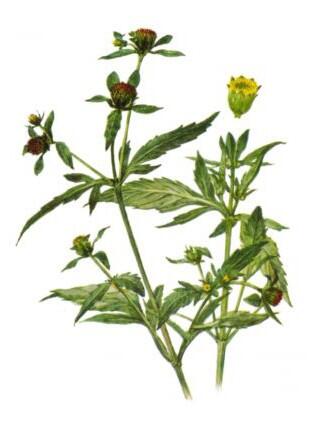
A herbaceous weed that has long been used for skin diseases in both adults and children.
An infusion of the herb is used internally for colds; externally - for exudative diathesis, pyoderma, atopic dermatitis, eczema with various etiologies.
The tripartite series belongs to the Aster family. The genus series includes over 200 species of plants growing in temperate and tropical regions of the globe.
Sequence tripartite is an annual herbaceous plant 30-100 cm high. The roots are taprooted, highly branched. Stems are solitary with opposite branching. The leaves are short-petiolate, opposite, mostly tripartite, dark green. The flowers are yellow, tubular, collected in single inflorescences of the basket. Each basket is surrounded by a double wrapper. As the fruits fade and form, the baskets darken and turn brown. The fruits are wedge-shaped compressed achenes with one longitudinal rib, obovate, with points at the top. The achenes are seated with denticles facing downwards, and there are denticles on the ribs of the achenes. The length of the achene is 5-8 mm, width 2-3 mm. The plant blooms from the end of June to September, bears fruit from the end of September.
The series grows in almost all regions of the European part of Russia (except for the Far North), as well as in Western Siberia, Central Asia, the Far East and the North Caucasus. Distributed in Belarus and Ukraine. It grows as a weed in damp places, in floodplains, near streams and swamps.
The herb contains carotene, essential oil, bitterness, vitamin C, tannins, mucus, lactones, amines, macro- and microelements. The following flavonoids have been isolated from the plant: luteolin, isocoreopsin, cynaroside, butein, sulfuretin, sulfurin, umbelliferone, scopoletin and esculetin.
The herb has many medicinal properties. The anti-inflammatory and antiseptic properties of the plant are attributed to the polyphenolic compounds that make up the tannins. Oil extracts of the succession herb, containing significant amounts of carotene, highly soluble in fats, also have anti-inflammatory and wound-healing properties.
The medicinal properties of the preparations of the series depend to a certain extent on ascorbic acid and manganese, which are important in physiological processes. Manganese ions in enzyme systems affect the processes of hematopoiesis, blood clotting, and the activity of the endocrine glands.
The effectiveness of using succession preparations in the treatment of patients with allergic skin diseases is also associated with the choleretic effect of the plant. The substances contained in the tripartite series are true choleretics (Isakova, 1980). Flavonoids and polysaccharides of the plant, acting together, influence the choleretic function of the liver.
The tincture of the series, when administered intravenously, has sedative properties, lowers blood pressure, increases the amplitude of heart contractions, and somewhat enhances the contraction of smooth muscle organs. As a diaphoretic, diuretic, vitamin and anti-allergic agent, the herb is taken orally for colds.
Since the plant improves metabolism, it is currently used for various
diathesis accompanied by urticarial rash, scrofulosis, neurodermatitis and seborrheic lesions of the scalp. Externally, the infusion of the plant is used to prepare herbal baths and herbal applications for patients with skin diseases. At the same time, the series dries the wound surface and promotes faster healing of the affected areas of the skin.
Various preparations are prepared from the string herb: infusions, tinctures, bath compositions, ointments with plant extract.
Historical reference
Among the people, the tripartite string has many names: scrofulous grass, goat's horns, marsh black-brown grass, dog's burrs, bident. The popularity of the plant in Russia was so great that its harvesting was carried out in 29 provinces. For a long time, the string was used only within the country; its medicinal properties were not recognized in the West. But Chinese and Tibetan traditional medicine recommended it for dysentery, eczema, and joint diseases.
In a Russian medicinal herbal book of 1893 it is written that the string is “useful for coughs...for diluting thick phlegm, the green herb applied to a wound from poisonous snakes soon heals it.” The tripartite sequence is described in the first three editions of the Russian Pharmacopoeia (1866-1880). The plant was then undeservedly excluded from the pharmacopoeia for more than a hundred years and appeared only in the 1990 edition.