

Wormwood herb
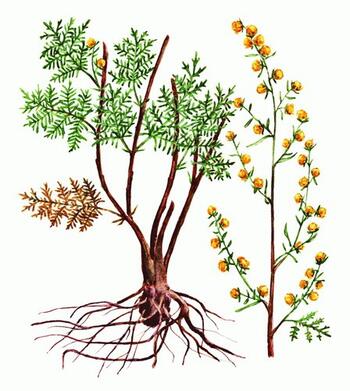
A herbaceous plant with a strong aroma and bitter taste. For medical purposes it is used to improve digestion.
Wormwood herb is used to increase appetite and improve the function of the gastrointestinal tract in hypo- and anacid gastritis; chronic cholecystitis; biliary dyskinesia.
Wormwood belongs to the Asteraceae family. The genus wormwood includes about 400 species of herbaceous plants and shrubs, growing mostly in the Northern Hemisphere.
Wormwood is a perennial herbaceous plant 60-100 cm high with a short rhizome. The root system is taproot. The stems are erect, woody at the base, branched at the top. The leaves are alternate pinnately dissected, the basal leaves are petiolate, the lower stem leaves are on short petioles, the rest are sessile. The middle leaves are twice pinnately dissected; the upper leaves are three-cut or entire. The leaves and stems are grayish-silver in color, densely pubescent. The flowers are small, collected in spherical baskets, located on short branches, which in turn form paniculate inflorescences. Each basket contains about 80 yellow tubular flowers. The fruits are brown achenes about 1 mm long. Blooms in June-August; the fruits ripen in August-September. The plant has a characteristic strong spicy aroma and a very bitter taste.
Wormwood is widespread in the European part of Russia (except for the northern regions), Western Siberia, and the Caucasus. It is found throughout Belarus, Ukraine, Kazakhstan and Central Asia.
It grows in young fallow lands, wastelands, near housing, near roads, in vegetable gardens, meadows, field boundaries and pastures, in steppe, forest-steppe, and less often forest zones. Sometimes it forms pure thickets.
The medicinal properties of wormwood are due to the active substances contained in the plant.
The herb wormwood contains essential oil (0.12-2%), flavonoids, tannins, carotene, lignans, organic acids, ascorbic acid, bitter lactones: absintin and anabsintin, coumarin substances (esculin, umbelliferone, coumarin), macro- and microelements.
An infusion of wormwood herb enhances the secretion of gastric juice, increases appetite, improves digestion, and has choleretic properties.
Infusion, extract and tincture of wormwood are used as a bitter to stimulate appetite and improve the functioning of the digestive system. By irritating the endings of the taste buds of the oral cavity, the active substances of the plant reflexively enhance the secretory function of the gastrointestinal tract. Absinthine plays a major role in this. It stimulates the function of the glands of the digestive tract, increases the secretion of bile, pancreatic and gastric juice. The activity of bitters appears 30 minutes after taking them.
When using wormwood preparations, pain and dyspepsia decrease or completely disappear, appetite improves, stool normalizes, the acidity of gastric juice increases, heartburn disappears, and gas formation decreases.
The medicinal properties of wormwood in the treatment of diseases of the gastrointestinal tract are enhanced when used in conjunction with other medicinal plants that have choleretic properties.
The bitter lactones absintin and anabsintin determine the anti-inflammatory and antimicrobial properties of the herb wormwood. Triterpenoid compounds of wormwood also cause a pronounced anti-inflammatory effect, stimulate the functions of the reticuloendothelial system and phagocytic activity.
Wormwood preparations increase the body's resistance to adverse factors, therefore, can be used after illnesses, influenza, in the post-infectious and post-operative period.
There is information about the bactericidal and fungicidal properties of unsaturated hydrocarbons isolated from wormwood. In addition, the plant exhibits antiseptic and phytoncidal activity.
Wormwood also reduces inflammation and heals wounds. Wormwood preparations in large doses cause stimulation of the central nervous system with subsequent depression.
In Rus', wormwood was a ritual plant; it was used during some holidays and rituals. On the girls' holiday Semik, it was a love spell. To do this, it was necessary to whip the chosen one with a wormwood stalk. On New Year or Christmas, houses were fumigated with the plant to protect against evil spirits and sorcerers. For this purpose, wormwood was plucked at the Assumption, consecrated in the church and stored until needed.
The ability of the plant to stimulate digestive processes was known in ancient times, as evidenced by the writings of Dioscorides and Pliny. As Pliny points out, during Roman celebrations, the winner of a four-horse cart competition received the right to take a sip of bitter wormwood tincture, because in those days they believed that health was the best reward.
Wormwood was grown in the monastery gardens of Western Europe in the 9th century. Its leaves were used to produce bitters - absinthe, especially popular in France. In the Middle Ages, wormwood juice mixed with sweet milk was considered an effective remedy “against worms in the belly.”